Scott Duncan
Just One LookScott Duncan is an Assistant U.S. Attorney whose work prosecuting corrupt politicians becomes inseparable from his effort to understand his sister Geri Duncan’s death. When Monte Scanlon, a convicted killer, asks to meet him privately, Scott discovers that the man has a personal connection to the case that has shaped his life. Scott’s investigation eventually leads him to Grace Lawson and to a set of clues suggesting that her own past may intersect with the identity Jack Lawson assumed. His disclosures illuminate the mystery without resolving every part of it: even at the end, Scott offers possibilities rather than a final account of what Grace once knew.
Identity and Background
Scott’s professional specialty is prosecuting political corruption, work he describes as a vigorous part of life in New Jersey. He is also an Assistant U.S. Attorney. The two descriptions coexist in the story: he has a defined professional field, yet later characterizes himself as a low-level lawyer in political-corruption cases. That contrast helps explain why Monte Scanlon’s insistence on speaking specifically to him initially seems inexplicable to others.
Scott is Geri Duncan’s brother. Geri died at twenty-one in a fire in her dorm room at Tufts University. Her death is not simply a family loss in his account of himself; it becomes the reason he leaves his job and pursues the circumstances surrounding her with exceptional commitment. His personal and professional identities thus pull in different directions. The investigation begins outside the ordinary demands of his work, but his legal position gives him a route into conversations and records that might otherwise remain inaccessible.
Monte Scanlon and the Revelation of Geri’s Death
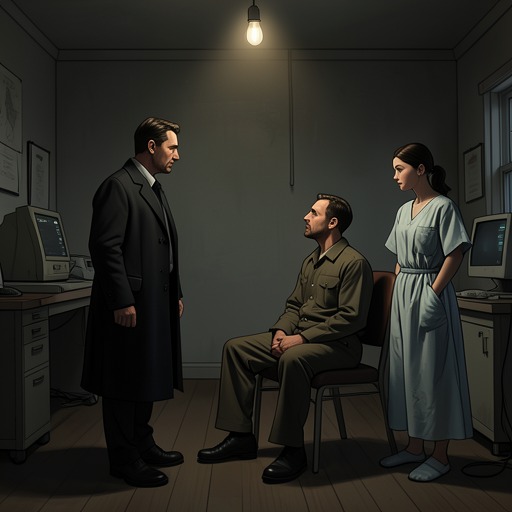
Scott’s first encounter with Monte Scanlon takes place in a windowless, gray room. Scott sits opposite the prisoner, who wears prison-issued orange and has his hands cuffed to the table. Scott has come because Scanlon, described as a mass executioner, broke his silence after three hours to demand a private meeting with him. The meeting sets a personal history inside a formal, guarded setting: Scott is the prosecutor facing a prisoner, but Scanlon claims to know him from long before their conversation.
When Scanlon says he has come to explain what he did to Scott, Scott replies that he does not know him. Scanlon answers that he has known Scott for a long time. He then invokes Scott’s sister by name, making clear that the meeting concerns Geri. The exchange transforms Scott’s uncertainty about why he was summoned into a direct encounter with the past he has been trying to understand. Scanlon’s disclosure is not presented as a complete explanation of his motives: when Scott asks why he is speaking now, Scanlon suggests only that Scott may have been right.
Scott later tells Grace Lawson that, three months earlier, Scanlon had insisted on seeing him despite Scott’s relatively low position in political-corruption work. Scanlon told him that he had killed Geri. Scott confirms this to Grace, who recognizes that Geri attended Tufts University. The account establishes what Scott learned from Scanlon and why the revelation changes the direction of his life; it does not supply every detail of the crime or settle every question about the people connected to it.
The Lawson Investigation and Scott’s Personal Involvement
Scott enters Grace’s search through the photograph that has become central to her questions about Jack Lawson. After Grace hurries toward the Photomat, a sandy-haired man stops her and identifies himself as Scott Duncan, from the U.S. Attorney’s Office. He points to the blonde woman in the cropped image, whose face has been crossed out, and tells Grace that she is looking at his sister. The photograph gives Scott a concrete point of contact with Grace’s investigation: Geri is not an abstract name from his past but a person depicted beside the man Grace is trying to find.
Scott eventually tells Captain Stuart Perlmutter that the Lawson case has a personal dimension for him. When Perlmutter asks about the crossed-out face in the photograph, Scott identifies the woman as his sister and agrees to begin at the beginning. This disclosure clarifies why Scott’s attention to the case exceeds ordinary professional involvement. He is trying to connect Geri’s death to the old events surrounding the photograph and to the disappearance of Jack, while also giving others enough information to understand why he is involved.
The investigation brings further loss into Scott’s orbit. Indira Khariwalla tells him that Rocky Conwell has been murdered and identifies Rocky as the man she hired to follow Jack. Scott says he heard about the death on the radio and asks who Rocky was. The exchange places Scott at the edge of another strand in the search: Rocky’s surveillance of Jack has ended in his death, and Scott learns the connection through the person who commissioned that surveillance. The available account does not show Scott directing Rocky’s work or knowing him beforehand; it shows him learning why Rocky mattered to the Lawson case.
What Scott Knows—and What He Withholds
By the time Scott speaks with Grace about Jack’s identity, he already knows that Jack was Shane Alworth. Grace reconstructs the possibility that Scott investigated Shane’s earlier life before they met, and Scott confirms that he knew. The admission changes the meaning of their earlier relationship as investigators: Scott was not approaching the question of Jack’s identity without prior knowledge. He had information relevant to the case before he and Grace began working together, although the account does not establish exactly when or how he obtained it.
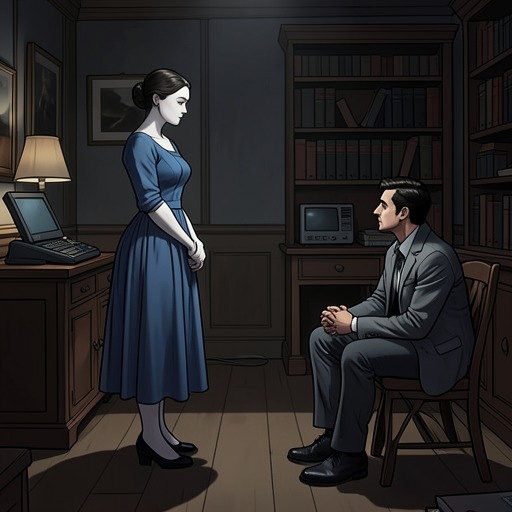
Scott’s final explanation draws on a dated original Polaroid. He tells Grace that Geri wrote the date on its back and that the picture was taken the day before the concert. He had the image enlarged and placed in Grace’s envelope. The photograph lets him propose a possible link between Grace and the earlier events: the barely visible woman at the far right, whom Grace thought might be Sandra Koval, could instead be Grace herself. Scott also points out that Geri never attended the concert. Since Shane Alworth and Geri broke up on the same day that Grace and Todd Woodcroft ended their relationship, he asks Grace to consider whom Shane might have taken instead. These details form a chain of suggestive coincidences, not proof of Grace’s identity in the image.
Scott extends the uncertainty to the incident backstage involving Jimmy X and Gordon MacKenzie. He raises the possibility that the young woman who distracted Gordon MacKenzie was neither Geri, Sheila Lambert, nor Sandra Koval. Grace refuses to believe she was that woman, saying she would have remembered. Scott accepts her response rather than insisting on his theory. He offers other possibilities: perhaps the unidentified woman kept Shane from going backstage, or perhaps he turned away because something in the front pit mattered more to him than pursuing the music. Scott also proposes that Shane might have found that person again years later. Each suggestion remains qualified; he does not claim to know which, if any, is true.
Ending and Narrative Significance
Scott leaves after handing Grace the cassette he had been playing. She takes it to her studio and paints Jack, distinguishing the person she wants to portray from the names John and Shane. Scott’s part in this ending is to return the evidence and leave the interpretation with her. He has brought forward Geri’s image, his own knowledge of Jack’s assumed identity, and a possible account of Grace’s place in the past; he has not converted those clues into certainty.
His arc is therefore shaped by a tension between investigation and restraint. The death of Geri drives him to pursue answers with a passion that leads him away from his job, while his later disclosures reveal that he knew more about Shane Alworth before meeting Grace than he initially told her. Yet when Grace rejects his theory about the photograph, he acknowledges that she may be right and gives her room to decide what the evidence means. Through Scott, the mystery links a sister’s death, an old photograph, and a concealed identity, while preserving the possibility that intimate connections can be real without being fully remembered or fully understood.